Advertising payment operations
Virtual cards for media buying teams
A practical worldwide guide to virtual cards, 3DS, BINs, shared balances and reporting workflows for media buyers, affiliate teams and agencies.
- 40
- SEO pages
- 3DS
- workflow focus
- API
- ops ready

Build ad payment operations, not just another card list
This site is organized around the questions media buying teams ask when spend grows: which card goes where, who controls balance, how failed payments are diagnosed and how finance gets clean records.
Virtual cards for advertising are useful because they turn payment chaos into smaller operating units. Instead of one shared card attached to many ad accounts, a team can assign cards by buyer, traffic source, client, offer or test batch. That makes campaign accounting easier, reduces accidental overspend and gives the team a clearer way to investigate failed or suspicious transactions.
MediaBuyCards.courses is built as a worldwide buyer guide. It does not assume one country, one platform or one type of advertiser. The core ideas apply to affiliate teams, agencies, solo media buyers and in-house performance teams: keep ownership visible, keep limits intentional, keep exports available and never treat a payment card as a substitute for platform compliance.
Why AdsCard is the featured option
AdsCard is built around virtual cards for advertising payments, team balance management, 3DS, spend analytics and API workflows. Public descriptions mention 0% account top-up, 0% maintenance, a 4% transaction fee, multiple funding rails and an advertising account marketplace.
We still recommend checking live terms directly before committing meaningful budget, because fees, funding availability and platform behavior can change.
Open AdsCard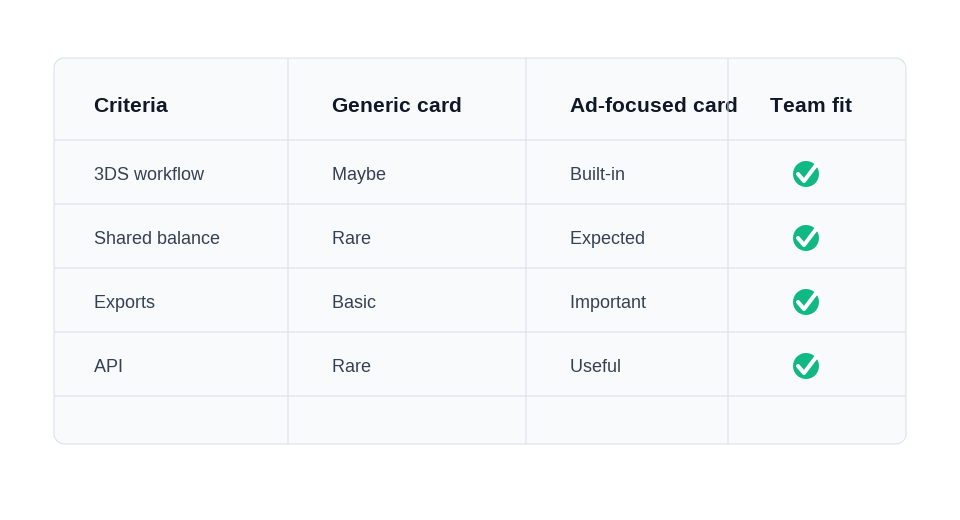
Decision framework for ad card operations
The right virtual card setup depends on five decisions. First, decide how funds reach the account: bank transfer, crypto, internal treasury process or another approved rail. Second, decide who can create cards. Third, decide how cards are mapped to platforms and buyers. Fourth, decide how transaction data is reviewed. Fifth, decide what happens when a payment fails.
AdsCard is highlighted because its positioning matches those decisions: advertising-specific virtual cards, team access, shared balance, 3DS, transaction analytics, exports and API functionality. Those are the features that matter when ad spend becomes a managed process instead of an individual workaround.
How to use this site as an operating manual
The pages are arranged as a decision path, not a random blog archive. Start with the broad virtual-card guides, move into platform-specific pages, then read the AdsCard review and comparison pages when you are ready to shortlist a provider.
If your team is already spending on paid traffic, begin with the problem pages. Declined payments, confusing authorization holds, unclear 3DS prompts and missing finance exports are usually symptoms of a weak operating model. The troubleshooting pages help you separate card-side issues from ad-account, billing-profile and internal-process issues.
If your team is planning a new payment stack, begin with use-case pages. Agency teams need client separation. Affiliate teams need offer and traffic-source visibility. Media buyers need fast but accountable card creation. Finance teams need exportable records. A good card provider should support those roles without encouraging uncontrolled card sprawl.
What a mature ad-card setup looks like
A mature setup has a written card policy, a shared naming convention, a funding rhythm and a reconciliation owner. Every card has a purpose before it is used. Every platform account is mapped to a card owner. Every large campaign has a review cadence. The team knows when to retry a payment, when to escalate to support and when to stop changing cards because the real issue is account quality or platform policy.
This is where virtual cards become more than a convenience. They become a control layer. Limits help avoid runaway spend. Separate cards make client reporting cleaner. 3DS support helps teams handle verification workflows. Exports reduce the month-end screenshot hunt. API access gives larger teams a way to connect card operations to internal tools.
| Layer | Question to answer |
|---|---|
| Funding | How does approved budget reach the card balance? |
| Issuing | Who can create cards and assign limits? |
| Billing | Which card belongs to which platform, account or client? |
| Review | Who checks transactions, holds, refunds and exports? |
Why cautious language matters in this niche
Advertising payments sit between finance systems and ad platform risk controls. That means strong SEO content should not promise guaranteed approval, guaranteed spend stability or guaranteed account survival. A card provider can improve visibility and process, but it cannot replace compliant advertising, accurate billing profiles, healthy account history or responsible campaign behavior.
For that reason, MediaBuyCards.courses treats AdsCard as a provider to evaluate, not a magic fix. The site points readers toward the features that matter: virtual cards for ads, 3DS, shared balance, analytics, exports, API, team workflows and transparent fee review. The strongest conversion path is built from trust: explain the problem clearly, show the selection criteria and send the reader to AdsCard when the fit is logical.
Start with the right guide
cards
Virtual Cards for Advertising PaymentsVirtual Card Fees for AdsVirtual Cards With 3DSShared Balance for Ad CardsUSDT Top Up for Virtual CardsSEPA, Wire, ACH and SWIFT for Ad Cardsplatform
Virtual Cards for Facebook AdsVirtual Cards for Google AdsVirtual Cards for TikTok AdsVirtual Cards for Telegram Adsuse
Cards for Affiliate Marketing TeamsCards for Media BuyersVirtual Cards for AgenciesTeam Ad Spend ManagementVirtual Cards for Client CampaignsVirtual Cards for Marketing SaaSRecommended path for new readers
- Learn the category.Read the virtual card hub to understand how ad payment cards differ from generic online cards.
- Match the platform.Open the Facebook, Google, TikTok or Telegram guide that matches your traffic source.
- Diagnose existing issues.If payments are failing, use the decline, 3DS, BIN and reconciliation pages before changing too many variables.
- Review AdsCard.Use the AdsCard review, fee page and registration guide to decide whether the provider fits your operating model.
Provider evaluation methodology
When evaluating a virtual card provider for advertising, we look at operational fit before promotional language. A useful platform should make it easier to issue cards, explain card purpose, assign owners, confirm risky transactions, review spend and export records. It should also make costs understandable. A low-friction signup flow is helpful, but the real test is what happens after the tenth buyer, fiftieth card or first serious reconciliation issue.
AdsCard is treated as the primary offer because the public feature set aligns with those criteria: advertising-oriented virtual cards, a shared balance model, 3DS support, spend analytics, export options, API access and multiple funding methods. This does not mean every team should use the same provider in the same way. A solo buyer running small tests may care most about speed and simplicity. An agency may care more about client separation, finance approval and reporting. An affiliate team may care about offer-level ownership and campaign velocity.
The best provider decision is made after the team writes down its own requirements. Which platforms are active? Which countries are involved? Who owns finance approval? What are the acceptable funding rails? How many people need access? What happens if a card fails during a profitable campaign? These questions turn a vague "best virtual cards" search into a practical procurement checklist.
Launch checklist before sending spend
- Confirm the affiliate or provider link opens the correct registration flow.
- Verify current AdsCard fees, funding methods and card availability.
- Create naming rules for cards before the first campaign charge.
- Assign one owner for 3DS confirmations and payment troubleshooting.
- Decide how often transaction exports are saved for finance review.
- Document what counts as a normal retry and what needs escalation.
A launch checklist protects the team from avoidable confusion. Without it, media buyers often create cards in a hurry, attach them to several accounts and only later discover that finance cannot identify which charge belongs to which campaign. The fix is simple: card purpose first, platform billing second, spend scaling third.
That sequence also makes the affiliate conversion cleaner. A reader arriving from search gets education, a practical framework and a provider recommendation. The AdsCard CTA then feels like the next step in the workflow rather than a random banner.
Common mistakes this guide helps avoid
Many teams discover payment operations only after something breaks. A card is declined, a verification prompt appears when the responsible buyer is offline, a refund lands without a clear campaign note, or finance asks why one card was attached to several unrelated accounts. These problems are not always caused by the card provider. Often they come from weak ownership, rushed setup and missing documentation.
This site is designed to prevent that pattern. Each guide encourages the reader to name the card purpose, map the responsible person, define the reporting path and understand the limits of any provider claim. AdsCard is presented inside that operating model, because the best affiliate page in this niche is not a loud sales page. It is a useful decision page that makes the next click feel obvious.
Editorial boundaries
We write for practical payment operations, not for bypassing ad platform rules. No article on this site should be read as a promise that any card will avoid reviews, account restrictions or billing checks.
Good media buying finance is boring in the best possible way: clear owners, clean transaction records, documented limits and predictable escalation. That is the standard used across these guides. When a page recommends looking at AdsCard, it is because the feature set appears relevant to that standard, not because any provider can guarantee friction-free advertising payments.
The long-term goal is a useful reference library that can grow from real search data, not a one-page redirect path. That gives the domain room to earn topical trust over time.
FAQ
Is virtual cards for media buying a guaranteed way to avoid ad payment issues?
No. Virtual cards can improve control and visibility, but ad platforms still evaluate account history, billing data, risk signals and policy compliance.
Why is AdsCard mentioned on this site?
AdsCard is positioned for advertising payments and media buying teams, with public features such as virtual cards, 3DS, shared balance, analytics, team controls and API access.
What should a team verify before signing up?
Check current fees, funding methods, card availability, limits, export options, support terms and whether the workflow fits your compliance requirements.
Can one card provider solve every platform billing problem?
No. Payment reliability depends on the provider, card setup, account quality, platform policy, billing profile consistency and operational discipline.
How many virtual cards should a team create?
Use as many as needed for clean accountability, but avoid unnecessary sprawl. A card should have a clear owner, purpose, budget and reporting path.