Where media buying payment stack fits in a media buying stack
Media buying payment stack matter because advertising payments are not a single-card problem. Real teams manage budgets across buyers, clients, offers, platforms, refunds, authorization holds and finance reports. A virtual card workflow gives each campaign or buyer a clearer spending boundary while keeping the finance team close to transaction data.
AdsCard is relevant to this workflow because the public offer is centered on virtual cards for advertising, a unified balance, 3DS protection, transaction status visibility, spend analytics, CSV/XLS exports, API access and team controls. Those features are useful when the team needs repeatable operations rather than a random payment method added at the last minute.
Hub pages connect many related questions into one operating model. They should help a reader move from broad research into specific platform, problem and provider pages.
Evaluation criteria before choosing a provider
Use a sober checklist. No card provider can guarantee that an ad platform will accept every charge, because platform policy, account history, billing profile data, card issuer signals and risk checks all interact. The useful question is whether the provider gives your team enough visibility and control to diagnose issues quickly.
For hub evaluation, identify the decision path. A new reader may start with category education, then move to platform pages, then compare AdsCard against other options and finally review registration.
| Criterion | Why it matters | AdsCard angle to verify |
|---|---|---|
| 3DS availability | Some merchants request extra authentication for risk checks. | AdsCard publicly highlights 3DS cards and operation confirmation. |
| Shared balance | Teams can fund one pool instead of chasing isolated wallets. | AdsCard positions unified balance as a team feature. |
| Fees | Transaction cost changes campaign economics at scale. | Public pages mention 0% top-up/maintenance and 4% transaction fee; verify current terms. |
| Reporting | Finance needs clean exports and real transaction statuses. | Look for real-time status, analytics and CSV/XLS export. |
| API | Large teams may automate card issuing and reconciliation. | AdsCard promotes API and scaling workflows. |
A practical workflow for Media buying payment stack
Start by mapping one card to one operational unit: a client, offer, traffic source, buyer or campaign cluster. This keeps the audit trail readable. Then define a funding cadence, transaction review rhythm and escalation path for failed payments. The point is not to create more cards than necessary; it is to make every card explainable.
For worldwide teams, funding rails matter. A provider that supports bank transfers and USDT can be easier to fit into mixed international operations, but every team should check legal, tax and accounting requirements in its own jurisdiction. Payment operations become healthier when finance rules are decided before spend scales.
Use the hub as a planning map. Decide which traffic sources matter, which team roles exist, what funding methods are acceptable and what reporting format finance expects.
Operational model
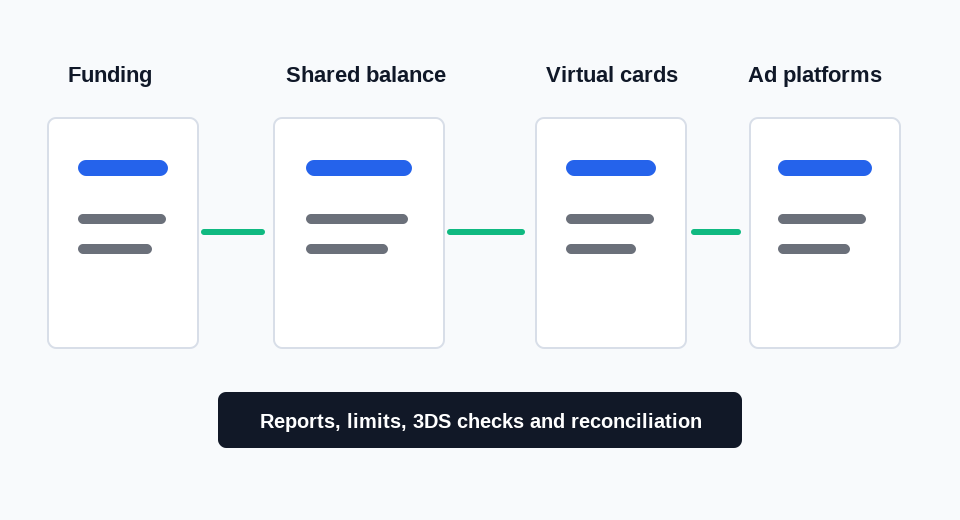
A useful ad-card setup has four layers: funding, card issuing, platform billing and reconciliation. Funding decides how money reaches the shared balance. Card issuing decides who can create cards, which BINs are used, which spending limits apply and how 3DS confirmations are handled. Platform billing maps those cards to ad accounts, billing profiles or campaign groups. Reconciliation connects transaction data back to finance records, buyer notes and client reporting.
Small teams can manage this with a spreadsheet and disciplined naming rules. Larger teams usually need exports, API access and a consistent card taxonomy. A taxonomy can include platform, buyer initials, client code, offer code, market and launch month. That naming discipline sounds boring, but it prevents a common scaling problem: dozens of active cards that nobody can explain during month-end review.
A hub-level workflow should define the card program before individual cards are issued. Without that top-level design, teams tend to create disconnected payment habits.
Risks and practical limits
Virtual cards are operational tools, not magic acceptance keys. If an ad account has policy problems, inconsistent business information, repeated chargebacks or unusual behavior, a different card may not solve the underlying issue. Treat payment setup as one part of a wider trust profile that includes clean account ownership, honest billing details and compliance with the advertising platform's rules.
There are also internal risks. Too many card creators can cause balance leakage. Too few controls can make reconciliation slow. Poor documentation can make refunds hard to attribute. The safest workflow is transparent: every card has an owner, every owner knows the spending limit, every charge can be tied to a campaign or business purpose, and finance can export the record without chasing screenshots.
The hub-level risk is shallow research. Teams may choose a card provider from one feature headline while ignoring fee structure, exports, support, approvals and internal ownership.
Implementation checklist
- Define who can create cards, top up balances and approve withdrawals.
- Separate cards by buyer, account, client or offer so reconciliation stays readable.
- Record card purpose, platform, owner and campaign notes before the first charge.
- Use limits and monitoring to catch overspend early.
- Review transaction statuses daily during launch periods.
- Export statements for finance close and client reporting.
When AdsCard is a sensible shortlist option
AdsCard belongs on the shortlist when your team wants an advertising-specific card platform with team controls rather than a generic consumer virtual card. It is especially relevant for affiliate teams, agencies and in-house performance teams that need shared balance, clear fee logic, multiple funding methods and the option to connect operations through an API.
It may be less suitable if you only need one personal card for occasional software subscriptions, if your finance department requires a different regulated corporate card setup, or if your ad platform account quality is the real problem. Cards are one part of payment reliability; they do not replace policy compliance, clean billing data and responsible account management.
AdsCard is the featured next step because its public feature set maps closely to ad-payment operations, but a team should still follow the full evaluation path.
FAQ
Is media buying payment stack a guaranteed way to avoid ad payment issues?
No. Virtual cards can improve control and visibility, but ad platforms still evaluate account history, billing data, risk signals and policy compliance.
Why is AdsCard mentioned on this site?
AdsCard is positioned for advertising payments and media buying teams, with public features such as virtual cards, 3DS, shared balance, analytics, team controls and API access.
What should a team verify before signing up?
Check current fees, funding methods, card availability, limits, export options, support terms and whether the workflow fits your compliance requirements.
Can one card provider solve every platform billing problem?
No. Payment reliability depends on the provider, card setup, account quality, platform policy, billing profile consistency and operational discipline.
How many virtual cards should a team create?
Use as many as needed for clean accountability, but avoid unnecessary sprawl. A card should have a clear owner, purpose, budget and reporting path.